





Flint advises international businesses and investors on policy, politics, regulation and competition.
Flint advises international businesses and investors on policy, politics, regulation and competition.
Quick links
Sectors
Follow Us


Allocation Round 8 (AR8) of the Contracts for Difference scheme is taking place in a markedly tougher political and economic environment than AR7, which secured a record 8.4 GW of offshore wind. With inflation at 3.5%, gilt yields near a 30-year high, growing network constraints and heightened scrutiny of energy bill levies, the Burnham government and DESNZ under Miatta Fahnbulleh are placing greater emphasis on affordability and value for money than on the Clean Power 2030 target. The initial budget will be published on 19 November, but DESNZ can review bids above budget in four of the five technology pots and raise budgets if they offer value for money, so the final capacity is not yet fixed. Flint expects the amount procured to depend on DESNZ’s modelling of the bill impact in the early 2030s, which HMT and No10 will scrutinise closely. Developers and investors should engage on the assumptions behind that modelling, particularly network build, gas and reference price curves, and electricity demand.
Allocation Round Eight (AR8) is the government’s next opportunity to secure renewable generation capacity. It is taking place in a markedly different political environment to AR7, which secured record volumes of offshore wind. With inflation now at 3.5%, gilt yields near a 30-year high, growing network constraints, and heightened political scrutiny of energy bill levies, the government will need to carefully balance the benefits of accelerating renewable deployment against the costs to households.
This blog sets out the process and timings of AR8, key elements of the auction design compared to AR7, and how the current political landscape may impact the amount of capacity procured in AR8.
The CfD scheme is the government's main mechanism for supporting investment in renewable electricity generation. It guarantees generators a strike price for their electricity, protecting them against wholesale price volatility. Generators receive a top-up when the market reference price falls below the strike price and repay the difference when it is above. Developers compete for contracts in a pay-as-clear auction – if successful, they receive a strike price equivalent to the clearing price set by the most expensive successful project. NESO administers the auction, while DESNZ sets the budget for the auction and each technology pot. The budgets for pots 1 - 4 may be revised upwards after bids are submitted.
AR8 opened to applications in July. Developers submitted applications demonstrating they meet the eligibility requirements to enter the auction and the delivery body (NESO) determined eligibility in September. Projects deemed ineligible are now in the appeals window. On 15 October, the government confirmed when it would publish the initial auction budget – the auction will then follow the timeline below:
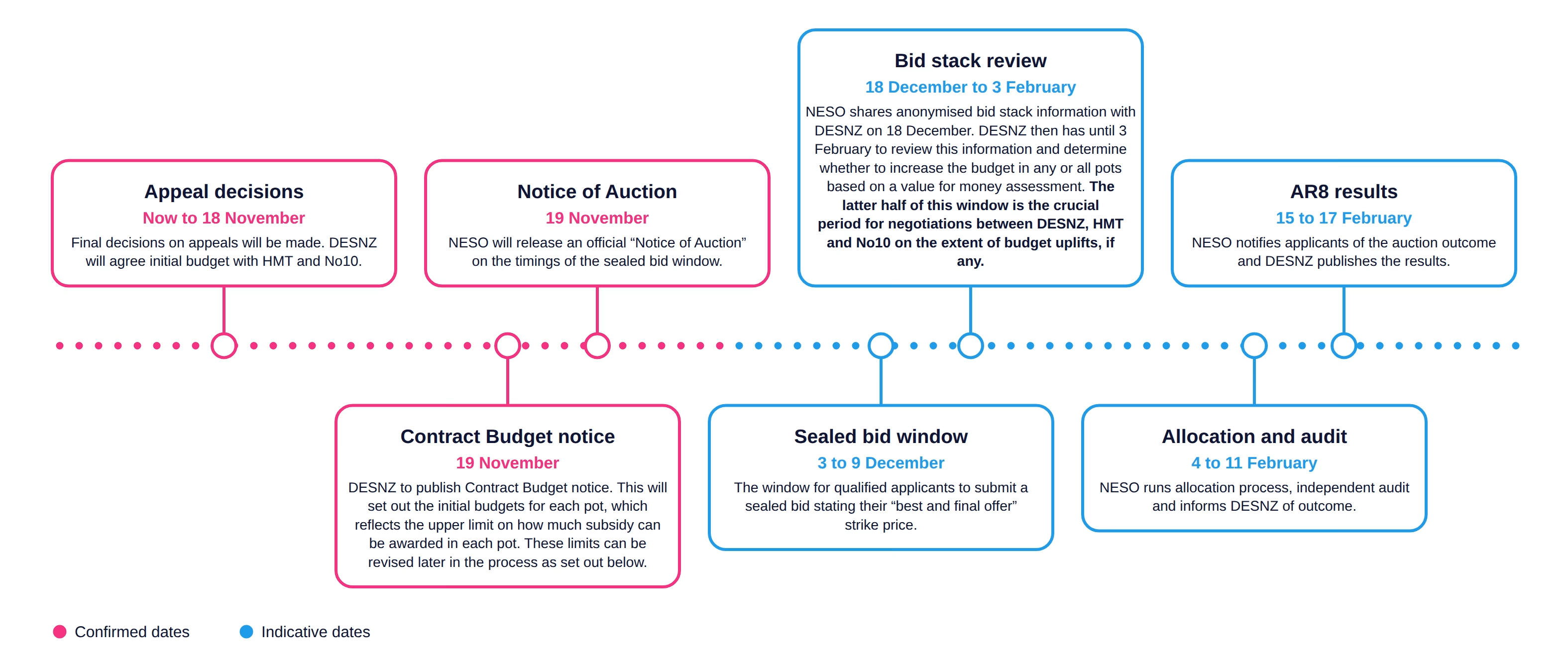
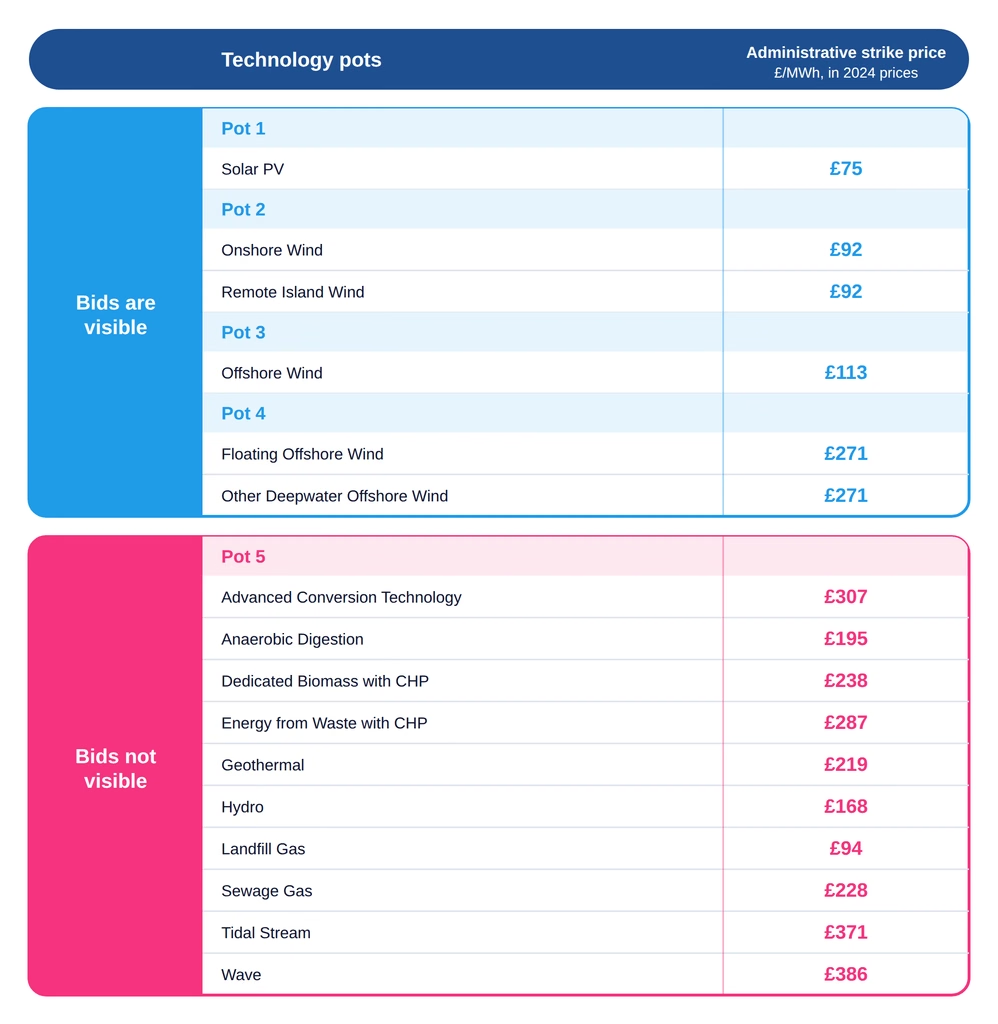
Beyond 19 November, the dates remain indicative and could be delayed. Importantly, the initial budgets will not necessarily determine the final amount of capacity procured. Building on reforms introduced in AR7, DESNZ will be able to review anonymised bids exceeding the initial budgets across four of the five technology pots. This will allow the government to assess whether increasing budgets could secure additional renewable capacity at a price that represents value for money.
AR8 builds on changes introduced in AR7, with solar and onshore wind now separated into distinct pots and greater bid visibility across more technologies.
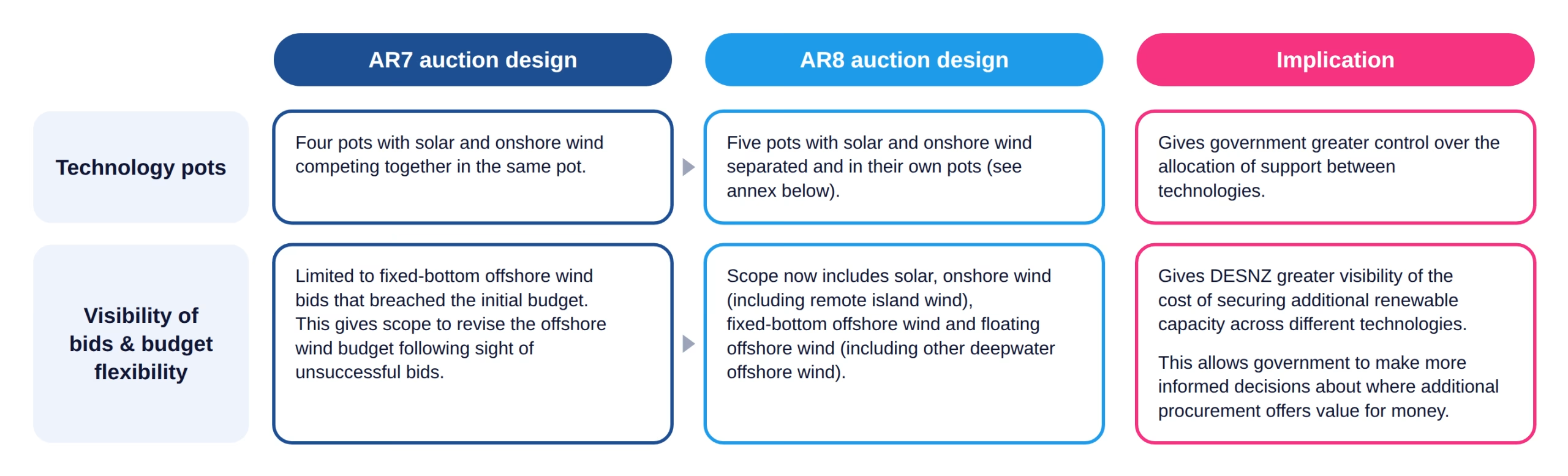
These changes give DESNZ greater understanding of the potential cost of additional renewable capacity across technologies before final budgets are determined. In AR7, the government used this flexibility to double the offshore wind budget, from £900 million to £1.79 billion, helping secure a record 8.4 GW of offshore wind capacity.
The government has expanded its scope to increase budgets across technologies. Whether it does so, and to what extent, depends on political will and the consensus reached across HMT, No10, and DESNZ regarding the impact on energy bills.
AR8 is taking place under different political leadership and a different context to AR7. Under Keir Starmer and Ed Miliband, Clean Power 2030 was a defining government priority, backed by Miliband's political influence and a willingness to commit substantial support to renewable deployment. The Burnham government, with Miatta Fahnbulleh now leading DESNZ, is placing greater emphasis on affordability in response to the conflict in the Middle East and rising energy bills. It is also applying greater scrutiny to new investment decisions, given growing concerns that renewables procurement is moving ahead of network build and electricity demand growth.
Fahnbulleh's recent speech to the Energy UK annual conference illustrated this shift. While reaffirming the importance of clean power, she suggested the 2030 goal was more about building confidence and momentum rather than the target itself. She also stressed that consumers ultimately judge the energy system by their bills, rather than the volume of renewable capacity installed.
This does not necessarily signal a retreat from clean power as an eventual goal, but it does suggest a change in how the government is framing its priorities. Against a backdrop of high energy costs and renewed concerns about energy security, AR8 will provide an early indication of how ministers balance the pace of renewable deployment with affordability and value for money.
This shift in political and system perspective is creating headwinds relative to AR7 but, ultimately, government will decide the level of capacity it procures based on modelling of the energy bill impact at the point AR8 capacity comes online. That modelling rests on a wide range of assumptions, the most influential being network build, future gas/reference price curves, and electricity demand. Given the political context set out above, DESNZ will be under significant pressure from HMT and No10 to demonstrate that its assumptions are robust, and that the proposed level of capacity will lead to lower system costs in the early 2030s.
Developers and investors should therefore engage on the assumptions behind this modelling, so that government has as well-informed a view as possible of how the electricity system will develop and can be confident that AR8 delivers maximum benefit to consumers. Beyond AR8, the question will be how the CfD scheme itself may need to evolve to support renewable deployment while delivering value for consumers.
If you would like to learn more and understand how Flint could support through this process, please get in touch here. Flint will publish analysis on the AR8 outcome and implications for the sector in the new year. Find our full series of blogs on our website here.
Phil McNally is a Director in Flint's energy practice where he supports a range of clients on energy policy and regulation. Prior to joining Flint, he was an energy adviser in No10. He is supported by Alice Coffey & Shaelyn Hattle who work across energy and infrastructure.