



Flint advises international businesses and investors on policy, politics, regulation and competition.
Flint advises international businesses and investors on policy, politics, regulation and competition.
Quick links
Sectors
Follow Us



On 3 January, Reuters reported that X’s AI chatbot, Grok, was generating “sexualized images of women and minors” in response to user prompts. Within days, governments in the UK, EU, Australia, Canada, India, Indonesia, and Malaysia had all expressed concern or taken action to address the issue.
Recent weeks have also seen other elements of tech regulation rapidly gaining contagious qualities. In the UK, the under-16 social media ban introduced in Australia late last year has now been embraced by the Conservatives and a growing number of Labour politicians, with Keir Starmer saying he was open to the proposal for the first time. Malaysia, France, Denmark, and a number of US states have also expressed a willingness to follow the Australian path. This policy was in part inspired by Jonathan Haidt’s Anxious Generation, which helped create a common discussion amongst policymakers globally.
Flint Global’s team based across Europe and Asia-Pacific have been closely tracking global developments. In this blog, we assess what this case shows about the spread of regulation from one part of the world to the other. A key conclusion is that where an issue strikes a nerve globally, regulatory contagion can occur in a matter of days. Businesses accordingly need to build an awareness of the global regulatory context and to anticipate how it may impact on them in their priority markets.
After social media and media reporting at the start of January, media, political, and regulatory responses rapidly proliferated around the world. A potted timeline helps to illustrate the pace of developments:
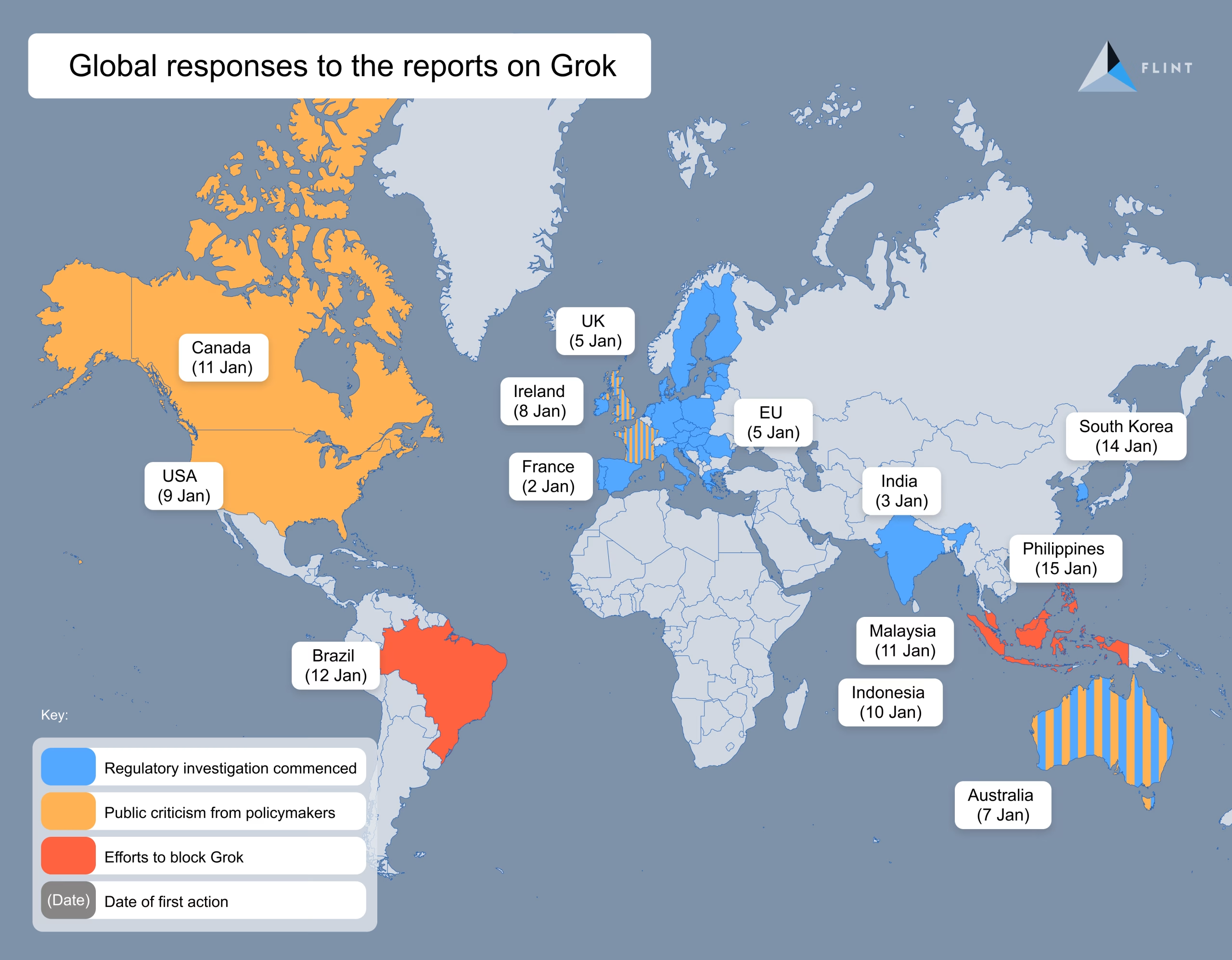
Stepping back from the Grok issue itself, these developments should prompt businesses across the technology sector to sit up and take notice. They demonstrate critical points on the nature of regulatory contagion in 2026. Although today, the primary focus is on Grok itself, the accelerating global spread of tech regulation is affecting firms across the sector.
We have three initial reflections on the implications for business:
It has been the case for a long time that policymakers in different parts of the world draw on lessons from other jurisdictions when developing policy. This includes in the tech sector, where there has been much discussion of the “Brussels effect”, whereby EU regulation such as GDPR ended up setting the template for regulation globally.
What the Grok developments show is that - on certain issues - policymakers in the tech sector are now monitoring each others’ responses and engaging with global peers in near-real time and calibrating their responses accordingly. This is particularly the case on issues that strike a nerve globally. The impact of digital technology on children and young people - especially how they interact with AI tools - is high up the political agenda across the world, so it is to be expected that governments will be closely tracking global developments on these issues. A key dimension is the effect of “enforcement optics”: once one regulator publicly signals action, others face pressure to be seen to act. This helps drive the pace of regulatory contagion.
A related point is that regulatory contagion is multidirectional: contrary to what was implied by the “Brussels effect”, it does not just flow from one direction to another, but rather there is a complex web of policymakers and regulators drawing on different parts of the world for influence. Certain countries in Asia-Pacific are now more willing to be first-movers. A notable example is Australia’s implementation of a ban on the use of social media for under-16s, a move that is being closely scrutinised by governments around the world.
Now more than ever, tech sector businesses need the tools to be able to track global developments and to assess what they mean for their products and services in different parts of the world. For businesses with a global presence, this primarily means having the functions in place to allow for rapid exchange of intelligence and analysis between teams based in different geographies. For businesses primarily located in one region, this means developing the mechanisms to monitor the networks of interaction and influence between their core markets and other parts of the world.
The social licence to operate for emerging technology is fragile. To varying extents, in different geographies there are increasing public and political concerns about the costs of technological innovation, whether that is the impact of digital services on children and young people, or the environmental impact of the increased demand for computing power arising from AI adoption.
Egregious examples of technology leading to harm will therefore inevitably capture the public imagination. Media reporting generates its own momentum, which in turn drives media reporting and political and regulatory responses around the world. On AI, up to this point many countries globally have expressed caution about regulating too quickly or too restrictively in a way that might inhibit adoption of the technology. However, public attention to high-profile instances of harm could harden policymakers’ stance on regulation. The risk is always that regulation is developed with the worst-case scenario in mind, regardless of whether the rest of the industry already has robust guardrails in place. The Grok case also illustrates how attention to one part of the tech “stack” impacts on other parts of the stack: app stores quickly faced pressure to remove access to Grok.
Companies in different parts of the tech sector must be prepared for this scenario. There is certainly value in trying to engage with and shape public and political perceptions of emerging technology, including by highlighting the economic and societal benefits as well as by demonstrating the responsibility of the industry as a whole. At the same time, businesses must be prepared for how high-profile instances of harm can upend these efforts and rapidly shift policymakers towards regulatory responses.
The Grok case shows how some issues - notably the protection of children - are a shared concern of policymakers globally. However, despite this shared concern, variations in political, regulatory, and cultural contexts will lead these issues to play out differently in different parts of the world. One notable difference in the Grok case was how - whereas regulators in the UK and EU followed established regulatory pathways to open investigations and seek further information, authorities in Malaysia and Indonesia moved swiftly to block access to the tool. This reflects key differences in regulatory practice.
On other issues, the divergences in response may be greater still. Definitions of the type of content that is harmful to children vary widely: in some countries this extends to LGBT+-related content or content that is critical of the government. This means that, even as policymakers draw on other parts of the world when formulating their approach, they will be tailoring global models and ensuring they fit the local context.
For businesses, this divergence of policy response has advantages and disadvantages, and how businesses perceive this may vary between cases. On the one hand, a context-specific approach to regulation can help to ensure that regulatory models suited to one jurisdiction are not transplanted wholesale to another jurisdiction, where they may be ill-suited to the regulatory and political context. Few regulators globally, for example, have the resources and experience at Ofcom’s disposal, which leads governments to think twice before copy-pasting the UK’s Online Safety Act into domestic law. However, divergence also means that regulatory fragmentation - and the cost of tracking and complying with different regulatory responses - will continue to be a fact of life for cross-border tech sector firms.
This blog was written by Ewan Lusty, Partner, Orla Middlemiss, Associate Director, and David Skelton, Partner. Ewan and David are based in Singapore and Orla is based in London. Over six years of working for Flint in Europe and Asia, Ewan has advised leading tech sector businesses on engaging with global regulatory trends. Orla brings experience from working on digital policy and regulation in the UK government and at the data regulator, the ICO, to support Flint clients. In addition to advising Flint clients on contagion of digital regulation, David experienced them directly when working for Google in senior policy roles for seven years across London and Singapore.