





Flint advises international businesses and investors on policy, politics, regulation and competition.
Flint advises international businesses and investors on policy, politics, regulation and competition.
Quick links
Sectors
Follow Us


Since his inauguration, President Donald Trump has imposed country-specific tariffs on Canada, China, and Mexico and threatened reciprocal tariffs on other countries. He has also announced steel and aluminium tariffs, due to take effect on 12 March, alongside threats of potential tariffs on other sectors, including automotive and pharmaceuticals.
This blog identifies countries and sectors most vulnerable to Trump’s tariff threats. We have not accounted for tariff threats arising from seemingly arbitrary grievances—such as the January 2025 threat to impose tariffs on Colombia after it blocked two US military planes carrying deported migrants from landing—which are probable but difficult to predict.
To do so, we have focused on long-running concerns about how specific countries interact economically with the US and perceptions of unfair treatment. These issues have largely been identified in the context of Trump’s America First Trade Policy Executive Order and Presidential Memoranda on trade and treatment of US companies.
The concerns include, but are not limited to:
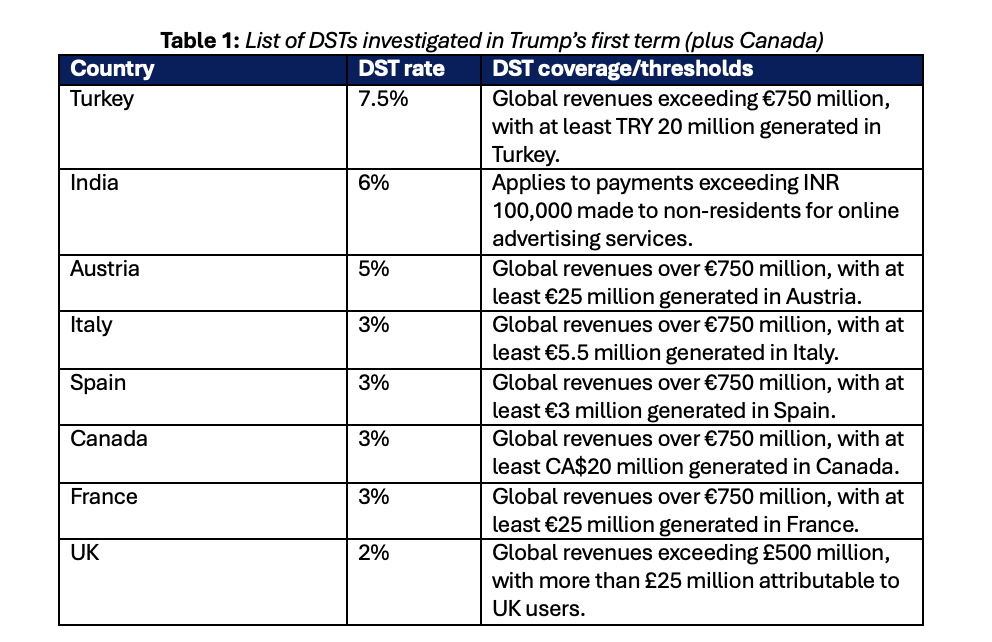
Other regulatory barriers
The US will also target other regulations which it believes impact its firms’ ability to trade and compete internationally. These encompass food safety regulations (e.g. on US shellfish) and digital regulations, including measures which are deemed by the Administration to target US companies explicitly and/or to restrict free speech. Examples of such regulation include the UK’s Online Safety Act, the EU Digital Markets Act and the EU Digital Services Act.
In Table 2, we identify the countries most at risk of country-specific tariff interventions based on the size of their trade surplus with the US.
We have calculated the possible country-specific tariff the US could apply to achieve reciprocity. This draws on Yale's The Budget Lab's reciprocal US tariff plus VAT “equivalent” tariff estimates.
Regulatory measures are more difficult to quantify, although we assume USTR will draw heavily from the findings of its annual Foreign Trade Barriers Report1 (Note: we have linked to the 2023 edition due to the Biden Administration removing lots of digital-related complaints in its 2024 report). However, where possible, we have included an estimated tariff rate equivalent for country-specific regulatory barriers based on World Bank estimates.2 In some cases, there is insufficient data to provide the potential value of non-tariff barriers for certain countries, which we have indicated with ‘N/A’. This lack of data may mean that total estimates of potential US reciprocal tariffs differ from predictions below.

US officials will identify sectors where the largest trade deficits as the highest priority for rebalancing trade. Those sectors are at the greatest risk of tariffs. However, Trump’s decision to provide automakers with a temporary exemption from tariffs on Canada and Mexico following lobbying from North American auto manufacturers demonstrates that sector-specific tariff exemptions are possible and that pressure from individual businesses can be an effective risk mitigation tool.
Table 3 sets out the top US imports globally, which shows how restricting access to the US market could significantly disrupt global markets. In some of the sectors with the highest deficits, the US share of global imports is as high as 30% of global trade.

In practice, a combination of country and sector-specific issues will inform the aggregate US tariff increase applied to an individual country. Sectors with which the US has the largest deficits for selected countries are set out below:

Businesses should ensure they understand the potential risks and opportunities that new US tariffs could have on their global operations and appropriately develop their engagement strategy with both the US government and governments in the markets in which they operate. Flint can help you assess these risks and develop strategies to mitigate them.
This blog was written by Rhys Davies, Kathryn Watson and Will Haworth. Rhys helps clients identify and manage market access barriers and opportunities – as well as the real-world impacts of geopolitical risks. Kathryn advises clients on geopolitics and trade issues across a range of sectors. Will advises clients on geopolitics and trade issues across a range of sectors, including on organisations’ exposure to US trade issues. He also provides advice on transaction clearance in sensitive sectors.