



Flint advises international businesses and investors on policy, politics, regulation and competition.
Flint advises international businesses and investors on policy, politics, regulation and competition.
Quick links
Sectors
Follow Us



APAC governments are shifting from digital ID pilots to utilisation in a wide variety of sectors. This transition requires businesses to move from adoption to participation in connectivity. As systems like Singpass and Aadhaar set benchmarks, the focus is now on ensuring smooth, effective, and safe use cases for consumers.
Businesses have an important role to play in ensuring that these systems benefit consumers, by working with governments and other stakeholders to ensure they are secure, trusted by consumers, and interoperable across jurisdictions.
For years, digital identity systems have been an aspirational goal for most of the Asia Pacific (APAC) region. Today, these systems have been rolled out across the continent. In the last five years the region has moved away from pilots and towards focusing on utilisation rates and applications for these systems. Early adopters such as India and Singapore have achieved 99% and 97% adoption rates for their Aadhaar and SingPass systems, respectively. With the EU planning its Digital ID rollout by late 2026 and the UK and US further behind, APAC is at the forefront of global implementation of digital identity.
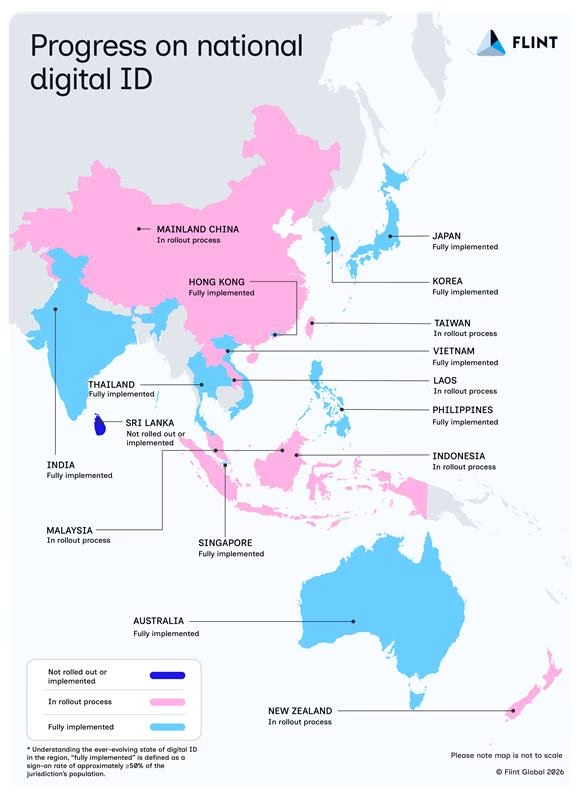
As these systems mature, governments are now working to apply them across their economies, including banking, payments, healthcare, social media and telecommunications. Current digital ID use cases in APAC include:
While consumer digital IDs are largely national and focused on individual citizens, there are growing calls for regional interoperability and digital identity for businesses. Interoperability is important because it prevents national systems from becoming isolated digital silos, ensuring the benefits of digital ID can scale across borders. While still developing, various interoperability initiatives between APAC countries have been piloted, such as the Chinese-led digital ID interoperability pilot with Hong Kong and Singapore, with the first cases including financial account opening and academic degree mutual recognition.
Additionally, the ASEAN Universal Business Identity (UBIC), launched in December 2025, aims to create a standardised way for businesses to prove their identity across borders. This would allow a firm in Indonesia to verify a partner in Malaysia with the same level of trust as it would with a domestic entity, helping to increase intra-ASEAN trade and further integrate the bloc.
As Asia moves to embed the use of digital ID infrastructure, affected businesses should be proactive in shaping how these systems are rolled out and adopted in practice. To manage the risks and improve the utility of these systems, firms can focus energies on three areas:
As our APAC Fintech Festival blog highlights, establishing trust is an increasingly important component of operating in fintech in the region.
Please get in touch if you would like to discuss the policy and regulatory development of digital ID in APAC and how to prepare your enterprise for the rapid developments. Our team includes technology, regulatory and political experts who understand how government and regulators are currently thinking about these issues.
This blog was written by Ewan Lusty - Partner, Adam Hendry - Director, and Adam Gear - Intern. Ewan, based in Singapore, has over eight years’ experience in Asia-Pacific and Europe across the public and private sectors on the policy and politics of technological change. Adam Hendry, based in London, advises clients on regulatory, policy and economic issues with a focus on financial services and technology. Adam Gear is an Intern at Flint with prior roles in payments at a bank. He is a student studying a BSc Computational Finance at the City University of Hong Kong
In Asia-Pacific, Flint Global is a strategic advisory firm helping businesses and investors navigate political, regulatory, and geopolitical complexity across 14+ jurisdictions. We combine on-the-ground knowledge, regional expertise, and global insight to help clients manage risk, engage effectively with governments, and make informed commercial decisions that create competitive advantage.
Our work in Asia-Pacific is driven by consultants and industry experts with deep experience in government, policy, and business, actively involved throughout client engagements. On-the-ground advisers work closely with clients, providing senior-level insight, challenge, and judgement, alongside practical expertise in key markets across the region. This ensures clients benefit from both local understanding and connectivity, and a broad regional and global perspective.