





Flint advises international businesses and investors on policy, politics, regulation and competition.
Flint advises international businesses and investors on policy, politics, regulation and competition.
Quick links
Sectors
Follow Us


This blog was originally published on 31 July and updated on 4 August. The implementation of reciprocal tariffs has now been postponed to 7 August. The US Executive Order confirms that the EU’s 15% tariff encompasses Most-Favoured Nation (MFN) rates. Although Japanese officials had suggested a comparable arrangement for Japan, the Executive Order does not reflect any such provision.
In the run-up to President Trump’s deadline for new tariff hikes, attention has largely centred on the headline ‘reciprocal’ tariff rate. Originally planned for implementation on ‘Liberation Day’ in April, these tariffs were postponed and are now set to take effect on Friday, 1 August.
Over the past few weeks, Trump has set revised rates for several countries, notably threatening India with 25%, Canada with 35%, and Thailand with 36%. Brazil saw the biggest increase to 50%, primarily driven by Trump’s criticism of the Brazilian government’s treatment of former President Bolsonaro, which he describes as “politically motivated persecution”.
These rates reflect a mix of Trump’s strategic objectives: his longstanding aim to use tariffs to raise tax revenue and bring manufacturing back to the US, as well as his propensity to use tariffs to address perceived grievances and pressure countries into changing policies he does not favour.
Most countries have accepted that pre-Trump tariff rates are no longer available. The average US tariff has increased from 2.5% to 16.6%, with projections suggesting it could reach 20% by early August.1 All of the announced deals with Trump have included implicit or explicit acceptance of a higher baseline tariff rate – most recently, the EU, South Korea and Japan have accepted a 15% tariff (instead of the threatened 30%, 25% and 25% respectively), and Indonesia and the Philippines have accepted 19%. Countries that have been unable to reach an agreement will receive a unilateral tariff rate from the US.
Rather than focusing on the absolute position, countries are becoming increasingly focused on their tariff treatment relative to their competitors. For example, under the new deals, while whiskey exported from the UK, the EU, and Japan has lost competitiveness against US-produced alternatives, UK whiskey (tariffed at 10%) has gained some competitiveness versus European and Japanese whisky (tariffed at 15%).
The specifics on individual deals also hold important nuances.
The deal with the EU clarifies that the pre-existing US most favoured nation (MFN) tariffs are to be incorporated into the 15% reciprocal rate. This contrasts with countries currently subject to the baseline 10% tariff, or countries which do not have a deal where the MFN tariff stacks on top of the baseline/reciprocal rate, such as the UK. Such technicalities can lead to some counterintuitive outcomes. For example, knitted bed linen2 (US MFN tariff of 6%) exported from the EU to the US will face a tariff of 15%, but the same product exported from the UK would face a tariff of 16%, despite the UK being subject to a lower headline rate of 10%. We expect countries subject to the 10% baseline to seek similar clarifications from the US as a result.
For some countries, the reciprocal tariff rate is only relevant to a moderate proportion of their exports to the US. Far more impactful are the existing Section 232 tariffs on steel and aluminium, autos (including parts), copper, and the growing list of Section 232 investigations still underway on pharmaceuticals, semiconductors and aerospace goods, to name a few. This is true, for example, of Chile, which, despite being subject to a 10% reciprocal tariff rate, is exposed to the 50% US tariff on semi-finished copper products, which accounts for around a third of its exports to the US.
As a result, trade-weighted tariff exposure can be different from the headline reciprocal rate. It also means that assessments of relative treatment need to be made on a sector-by-sector basis.
At the sectoral level, automotive imports are particularly illustrative. The US imports nearly half of all new cars sold, with the majority coming from six major trading partners: Canada, Germany (EU), Japan, Mexico, South Korea, and the UK, all of which now have deals with the US and, according to current reports, will not be facing the S232 25% tariff.
Based on 2024 export figures, the effect of Trump’s auto tariffs on these markets is outlined below (*UK figure is based on a TRQ of 100,000)
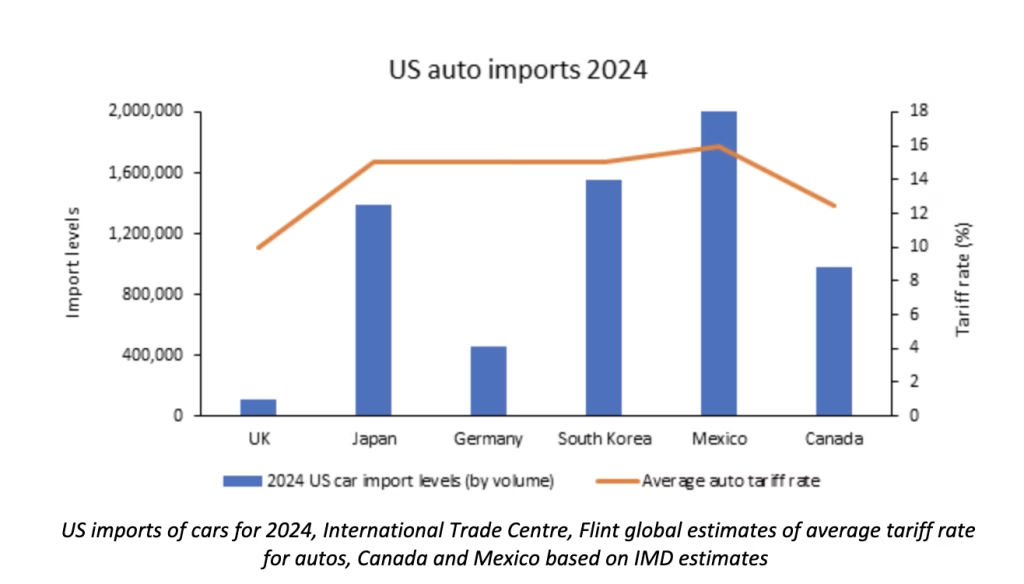
The recent deals also diminish the preferential treatment previously given to firms manufacturing in Canada and Mexico. These countries face a 25% tariff on vehicles unless they comply with the strict rules of origin under the USMCA, which grant zero tariffs only on the US-made portion of a vehicle. For Mexico, where the average non-US content in vehicles is estimated at 60-70%, this translates to an effective average tariff of nearly 16% – the highest among all six trade partners.
There also remains a strong possibility that the US will introduce company-specific tariff exemptions. These are likely to be temporary and conditional, potentially tied to investment commitments, energy purchases or reshoring efforts. Outside of automotive, the pharmaceutical sector is one we view as being prime for such country-to-company bargaining. This could provide some flexibility for firms, particularly those with significant US operations or strategic importance to supply chains.
With the US increasingly adopting differentiated tariff treatment by country and by product, businesses should expect greater scrutiny around rules of origin. The US has made this a key focus of its trade policy, threatening countries with higher tariffs for ‘transhipment’ – primarily targeting Asian countries as a means to prevent any Chinese circumvention. Even when trade agreements are reached, such measures are often embedded in the terms. For example, the US-Vietnam agreement included a provision accepting a 40% tariff on all goods transhipped through Vietnam.
A particularly acute example of where tariff differential could create problems for exporters is between Ireland and Northern Ireland. Irish exports (EU) subject to the reciprocal duty will face a 15% tariff when entering the US, while Northern Irish exports (UK) should face a 10% tariff. Enhanced enforcement is already visible, with US authorities clamping down on transhipment practices and tightening compliance checks. This will lead to higher administrative and compliance costs for exporters.
The 1 August deadline marks the start of reciprocal tariff implementation, but more disruptive measures could follow. The trend is clear: the US market is becoming more closed off, with no return to pre-Trump tariff baselines in sight. We continue to work on the basis that average applied US tariffs will be 15-20 percentage points higher at the end of the Trump Presidency than the beginning.
Companies should assess their US exposure not just in absolute terms, but relative to their competitors. Consider whether alternative supply routes or production hubs offer a more favourable tariff profile. However, shifting production is not without risk – particularly if origin rules tighten or exemptions are revoked.
In short, businesses must closely monitor developments, stress-test their supply chains, and plan for a US market that is structurally more closed, more complex, and more costly to access.
[1] US Tax Foundation, Trump Tariffs: The Economic Impact of the Trump Trade War
[2] HS 6302.10.00
Enjoyed this blog? Sign up for our Trade Monthly newsletter for analysis of the political, policy and regulatory developments shaping UK, EU and global trade.