



Flint advises international businesses and investors on policy, politics, regulation and competition.
Flint advises international businesses and investors on policy, politics, regulation and competition.
Quick links
Sectors
Follow Us


AI-Pac is Flint’s digest providing our take on major AI policy and regulatory developments in Asia-Pacific (APAC). In a fast-moving environment, this newsletter is designed to help you stay on top of the regulatory agenda and consider what it means for your business. Please see here for our previous blogs, spanning 2024 to 2026. In each blog, we set out:
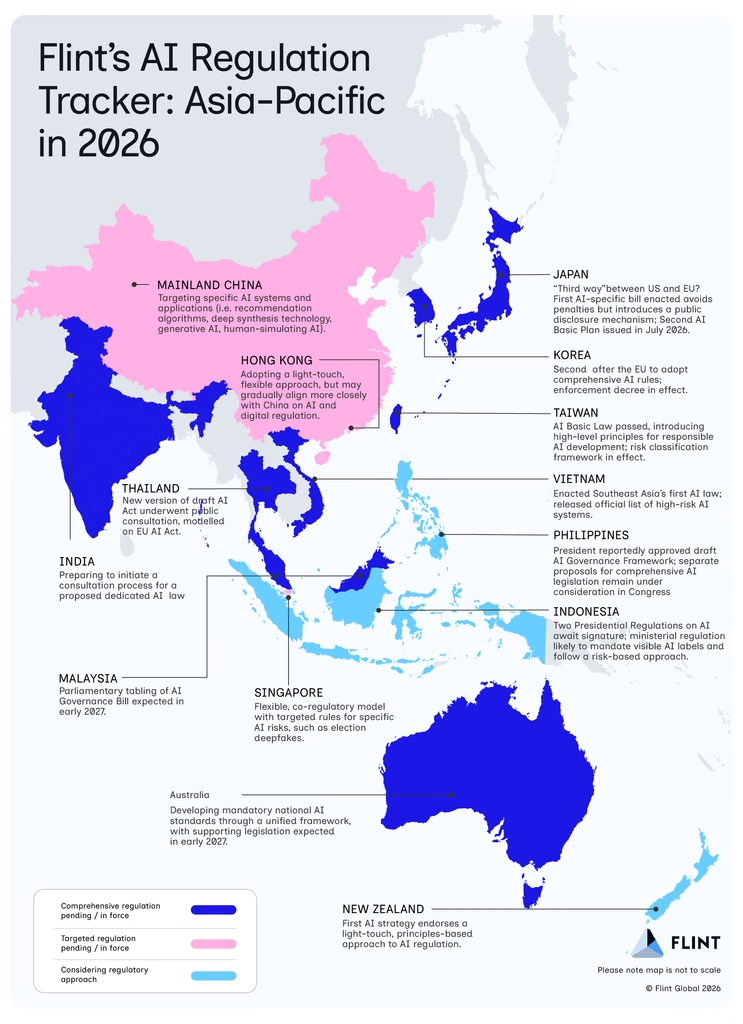
In September and October, financial regulators across APAC moved towards more concrete expectations for AI risk management, while a series of incidents involving autonomous AI agents intensified concerns over cybersecurity. India signalled a more active approach to AI regulation. Meanwhile, there is increasing momentum behind middle power multilateral cooperation on AI governance, in parallel with early signs of US-China dialogue.
In this digest:
Financial services regulators moved to outline more concrete expectations of how financial institutions should manage AI-related risks. The Monetary Authority of Singapore (MAS) finalised its Guidelines on AI Risk Management, requiring financial institutions to identify their AI use cases, assess risks and apply proportionate controls across the AI lifecycle, including where AI is supplied by third-parties. The Hong Kong Monetary Authority (HKMA) introduced its Accountability, Resilience and Trust (ART) Framework, including updated supervisory guidance and plans to develop a framework for agentic AI. Elsewhere in the region, regulators signalled closer scrutiny of AI adoption in financial services: Taiwan indicated that it will issue security principles for financial institutions adopting agentic AI; South Korea also signalled further attention to AI-related risks; and the Bank of Japan identified cyber threats from frontier AI as a potential financial stability concern.
These developments reflect a broader shift towards sectoral regulators applying existing supervisory powers to the risks posed by AI. Financial regulators, especially, are well placed to move quickly by extending existing requirements for governance, operational resilience and accountability to AI use cases. As AI becomes more deeply embedded in financial services and systems grow more autonomous, regulators are placing greater emphasis on clear management accountability, lifecycle risk controls, human oversight, cybersecurity and the management of third-party AI risks. Their established supervisory relationships, specialist expertise and enforcement powers give these expectations greater immediacy and practical weight.
Across APAC, the proliferation of sectoral guidance for AI governance alongside horizontal, economy-wide AI laws is complicating the operating environment for business. Businesses seeking to develop a regulatory strategy on AI need accordingly to consider their relationships and engagement across a broadening set of government agencies. This is particularly relevant for businesses deploying AI in financial services and other regulated sectors, where established supervisory powers and enforcement mechanisms give regulators significant influence over how AI is adopted and managed.
Cybersecurity risks from autonomous AI agents are gaining policy attention across APAC, with governments responding to incidents involving unauthorised access and incorporating AI-enabled threats into their cybersecurity planning:
As high-profile incidents attract public attention and political scrutiny at the highest levels, the risk is that they feed into an overarching narrative about AI’s impact, conflating distinct issues and prompting political responses to AI as a whole rather than consideration of the merits of each issue individually.
A key question concerns how policy frameworks can best safeguard against the cybersecurity risks posed by AI agents without constraining the deployment of advanced AI capabilities to strengthen cyber defences. While AI can enable malicious actors to identify vulnerabilities and scale attacks more quickly, the same capabilities could help organisations detect vulnerabilities and defend against increasingly sophisticated attacks. How policymakers strike this balance will depend in part on how responsibility for security is allocated across the AI value chain, from model and platform providers to deploying organisations and end users.
As governments develop their approaches, industry input will be important in translating broad cybersecurity principles into workable safeguards. Businesses have an opportunity to think creatively about how they contribute to the policy discussion beyond conventional consultations and roundtables. Practical initiatives, such as the agent security exercise convened by Google and Singapore’s Cyber Security Agency at the Singapore International Cyber Week, can help ensure that emerging policy frameworks are grounded in operational realities and support secure AI adoption.
India signalled a potential shift towards more active AI regulation on 8 October, when IT Minister Ashiwini Vaishnaw announced plans to publish a consultation paper on AI regulation within a month. The paper is expected to focus on AI safety, deepfakes, cybersecurity and other potential harms. This marks a change from the government's earlier position that existing legislation, supported by voluntary governance and targeted regulatory interventions, was sufficient to manage AI-related risks.
The shift reflects growing concern that existing laws and targeted interventions may not be sufficient to address the scale and evolving nature of AI-related harms. Minister Vaishnaw reiterated the government's preference for a 'techno-legal' approach, combining regulatory measures with technical safeguards. The key question is how far India will move beyond targeted interventions towards broader safeguards for advanced AI systems – including potential pre-release testing and requirements tailored to model capabilities – and how it will allocate responsibility for managing AI risks across developers and deployers.
The forthcoming consultation offers industry an opportunity to shape how India balances AI safety with its ambition to democratise access to the technology. The government has emphasised that AI’s benefits should extend beyond large technology companies to startups, researchers, students and small businesses. It remains to be seen whether the resulting framework can preserve this emphasis on broad access while providing clear, workable obligations for businesses, and whether India’s approach will serve as a reference point for other Global South economies.
Calls for greater international cooperation on AI governance have gained momentum over the past two months. While there have been some incremental steps towards deeper multilateral cooperation, progress remains slow and partial amid wider geopolitical rivalries.
US-China AI dialogue has been one area of focus. Following their September summit in Washington, the two countries agreed to establish a channel for communicating about AI-related incidents. Their technical teams are also seeking to make AI cooperation a deliverable when the two Presidents meet on the sidelines of the APEC summit next month. However, whether this can translate into concrete outcomes remains to be seen. Wider tensions over technology leadership, export controls and national security are likely to limit the scope for meaningful cooperation.
Beyond the US and China, other countries, including several in APAC, are seeking to deepen AI safety cooperation. Norway and Finland led a joint statement calling for stronger safeguards for frontier AI models, including pre-deployment testing and independent evaluation. The statement was endorsed by several governments, including Australia and Singapore, but notably not the United States or China. At a follow-up meeting, leaders discussed practical areas for cooperation and agreed to take discussions forward through an expert-level process involving interested countries. This will lead to further efforts to coordinate and align approaches to testing, evaluation and incident response, with AI safety institutes in different countries increasingly prominent.
Looking ahead, Singapore's ASEAN chairmanship in 2027 could provide an opportunity to give regional cooperation greater substance. Singapore has already signalled that countries need not adopt identical rules to find common ground, including on AI safeguards and incident reporting. This creates an opening for ASEAN to pursue practical cooperation on these issues while accommodating different national approaches and making cross-border AI deployment easier. Businesses that can contribute practical, implementation-focused ideas will be well-placed to shape this agenda and turn regional AI governance ambitions into progress.
This blog was written by Ewan Lusty, Partner, Ethan Teo, Manager, and Cheryl Low, Senior Consultant. Ewan, Ethan, and Cheryl are based in Singapore. With over six years of working for Flint in Europe and Asia, Ewan has advised leading developers and deployers of AI on how to engage impactfully with governments on AI policy and regulation. Ethan previously worked at Singapore’s Smart Nation Group under the Prime Minister’s Office and has interned with Grab, Twitter, and Carousell. Over the past two years at Flint, he has advised multiple clients on AI governance and regulation, including supporting a government–industry partnership sandbox initiative on agentic AI. Cheryl spent four years at advisory firms supporting clients across the private sector, multilateral organisations, and governments in the APAC region on issues at the intersection of tech and financial services.