



Flint advises international businesses and investors on policy, politics, regulation and competition.
Flint advises international businesses and investors on policy, politics, regulation and competition.
Quick links
Sectors
Follow Us


AI-Pac is Flint’s digest providing our take on major AI policy and regulatory developments in Asia-Pacific. In a fast-moving environment, this newsletter is designed to help you stay on top of the regulatory agenda and consider what it means for your business. Please see here for our previous blogs, spanning 2024 and 2025. In each blog, we set out:
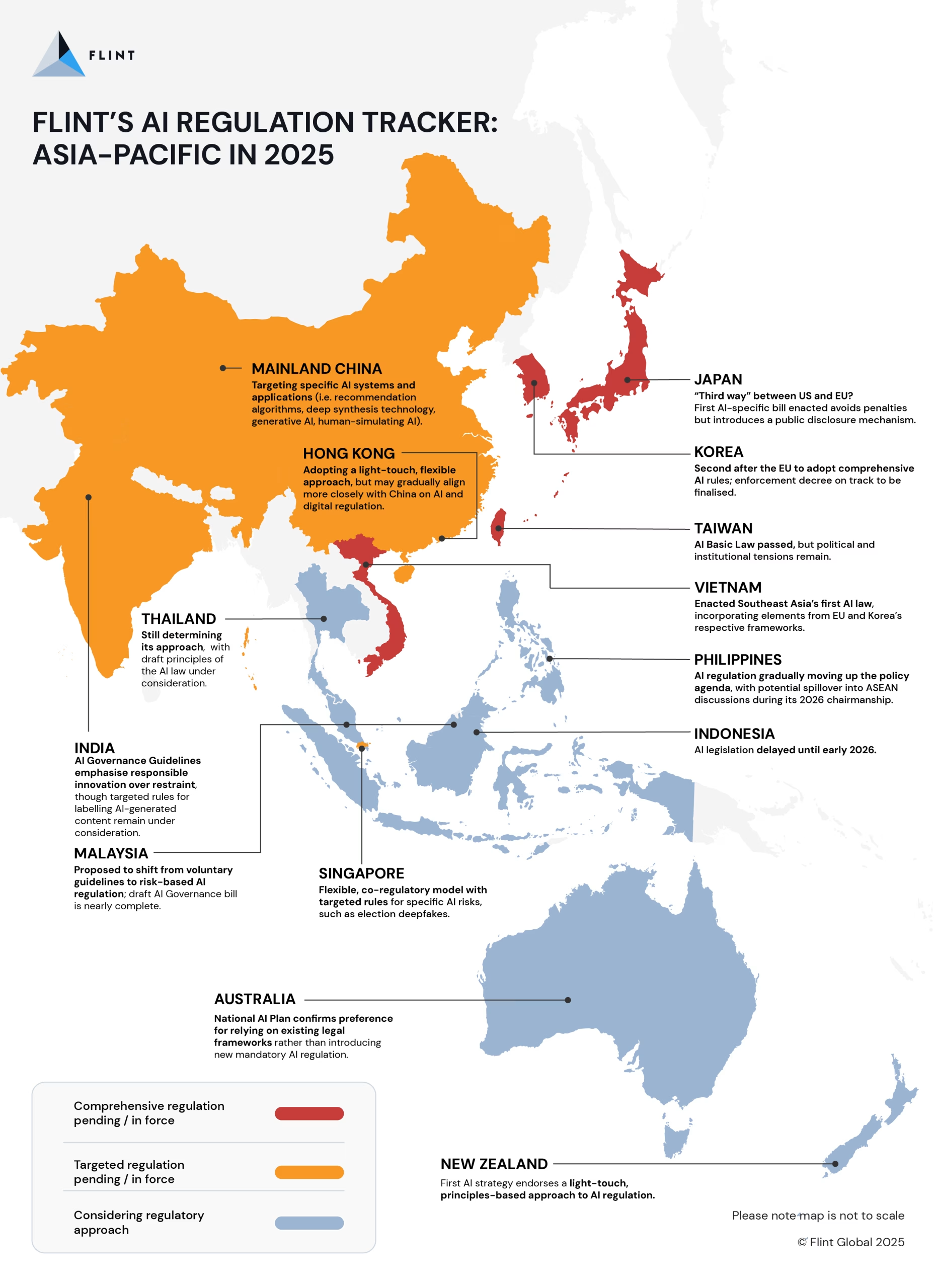
In November and December, there was continued movement on several pending AI legislative proposals and clearer signals about the direction of travel in key markets. Across the region, governments remain cautious about regulating AI in ways that constrain competitiveness. Diverging approaches are contributing to regulatory fragmentation, as some jurisdictions advance AI-specific laws while others rely on principles-based guidance or existing legal frameworks. In this digest:
If you would like to discuss how AI policy and regulation in Asia-Pacific will impact on your business, please get in touch with the team here.
India is positioning itself as an AI governance leader for the Global South, particularly ahead of the AI Impact Summit in February 2026. On 5 November, the Ministry of Electronics and Information Technology (MeitY) released the ‘India AI Governance Guidelines - Enabling Safe and Trusted AI Innovation’, authored by Flint Senior Adviser Amlan Mohanty, which sets out a “balanced, agile, flexible, and pro-innovation” approach to AI governance.
India’s current direction is to avoid sweeping, horizontal AI legislation in favour of non-binding guidance and iterative, issue-specific regulatory measures. MeitY Secretary Krishnan publicly stated that India’s immediate priority is innovation rather than regulation, corroborating private indications that India aims to avoid what is seen as Europe’s overly cautious regulatory approach, and instead to prioritise responsible innovation over restraint.
That said, the guidelines are unlikely to be the final word on India’s AI regulatory approach. The guidelines stop short of taking firm positions on several contested issues, leaving open questions around how India’s approach will evolve in practice. Parallel policy processes are already underway, including proposed amendments on labelling AI-generated content, reports on AI and competition, and work on a responsible AI framework for the financial sector. A government panel has also been exploring a proposal for a mandatory blanket licence allowing AI developers to access lawfully obtained copyrighted works for training.
The timing of the report – released under the banner of the AI Impact Summit – underscores India’s intent to showcase its governance model on the global stage. Early reactions have been largely positive, though some critics argue that it relies too heavily on voluntary measures and lacks operational detail, particularly around accountability. This may in future lead to pressure to implement a more prescriptive framework. For now, the framework shares similarities with approaches in Japan, South Korea, and Singapore, and will be of interest across the Global South. Governments will be assessing whether India can follow a middle way between the EU’s more prescriptive regulatory framework and the US’s market-led approach. For businesses, this makes India’s positioning a potential reference point to monitor closely and draw on when engaging with regulators in other markets.
Vietnam has moved decisively ahead with AI legislation, setting a precedent as other countries in Southeast Asia consider whether new laws are necessary or whether existing frameworks supplemented with guidelines are sufficient to address AI risks. On 11 December, the National Assembly approved Vietnam's first AI law, scheduled to take effect in March 2026.
The law adopts a risk-based framework inspired by the EU, but with notable refinements from earlier drafts (discussed in our previous blog). The number of risk tiers was reduced from four to three – low, medium, and high – with separate provisions addressing prohibited AI-related behaviour. Providers of high-risk AI systems will no longer need prior approval to operate, but must prepare safety assessment documentation and produce it upon request. Compared with earlier drafts, the final law removes revenue-based penalties and scales back several obligations viewed by industry as overly burdensome, signalling a deliberate effort to reduce compliance costs and preserve room for innovation.
The framework reflects influence from multiple regulatory models, incorporating elements of the EU AI Act and Korea’s AI Basic Act while adapting these approaches to Vietnam’s domestic priorities. As Southeast Asia’s first AI law, Vietnam’s framework is likely to inform debates in other regional markets, including the Philippines – where President Marcos has recently stressed the need to regulate AI – and Indonesia, where planned AI regulation has been delayed until early 2026.
For businesses, much will depend on forthcoming implementing decrees and technical guidance, particularly given the broad and sometimes ambiguous definitions of risk tiers, which afford regulators significant interpretive latitude. While the AI law ultimately removed earlier proposals on data localisation and registration for foreign firms, Vietnam’s revised cybersecurity law – passed on the same day – continues to impose localisation and access obligations on foreign service providers. This divergence creates a more complex and fragmented compliance landscape with potentially overlapping requirements that businesses will need to navigate carefully.
As AI becomes a central pillar of economic strategy across Asia-Pacific, Australia, Japan, and South Korea have each moved to formalise national AI plans aimed at accelerating adoption, investment, and domestic capability-building. On 2 December, the Australian government released its National AI Plan, which prioritises the growth of domestic AI capabilities and establishes an AI Safety Institute. The Plan confirms a preference for relying on existing legal frameworks rather than introducing new mandatory AI regulation, marking a clear departure from earlier discussions.
Japan took similar action on 23 December, approving an AI Basic Plan aimed at becoming “the world’s best country to develop AI.” Acknowledging that it lags major powers in AI investment, the government framed the plan as a national “counteroffensive”, positioning AI as a core engine of economic and social revitalisation. The strategy emphasises the development of “trustworthy AI” trained on high-quality data, sector-specific deployment in areas of traditional strength such as manufacturing and medicine, the use of regulatory sandboxes, and expanded talent development.
Meanwhile, on 15 December, South Korea released details of a draft National AI Action Plan, to be finalised in early 2026. The plan outlines 98 tasks across three pillars: building an AI innovation ecosystem, driving a nationwide AI-led transition, and contributing to a global “AI basic society.” It includes proposals to amend the AI Basic Act to align more closely with evolving global governance frameworks, establish a national superintelligence research institute, and actively support exports of Korean AI technology, infrastructure, and data.
These developments underscore a regional push to prioritise AI competitiveness and capability-building over restrictive guardrails. This creates an opportunity for businesses at each level of the AI stack to strengthen credibility with policymakers by building narratives about how their activity supports the priorities set out in these national plans, such as productivity gains, sectoral deployment, skills development, and export potential.
Following months of negotiation and debate, Taiwan has moved to formalise its AI governance framework. On 23 December, the Legislative Yuan passed the AI Basic Act, which sets out seven core principles for AI development, including sustainability and well-being, human autonomy, privacy and data governance, cybersecurity and safety, transparency and explainability, fairness and non-discrimination, and accountability. The Act also prohibits AI applications that harm life, freedom, property, or social order; undermine national security or the environment; or engage in bias, discrimination, misinformation, or fabrication.
While the Act establishes high-level principles, it leaves significant questions around implementation unresolved. The National Science and Technology Council (NSTC) is designated as the competent authority while the Ministry of Digital Affairs is tasked with developing an AI risk classification framework. Uncertainty remains over whether subordinate regulations should be led by the NSTC or the Ministry of Digital Affairs (MODA).
These uncertainties reflect deeper institutional and political tensions shaping Taiwan’s AI governance. Opposition lawmakers from the Kuomintang and Taiwan People’s Party have argued, for instance, that clearly designating a competent authority is essential for regulatory clarity and speed, while members of the ruling Democratic Progressive Party have resisted doing so, citing concerns about politicisation. As implementation moves forward, businesses should be mindful that these unresolved questions could lead to overlapping responsibilities, and should monitor how institutional roles evolve in practice.
With this edition, AI-Pac has now covered two years of AI policy and regulatory developments across Asia-Pacific. While 2025 saw a number of APAC governments develop their AI regulatory approaches, 2026 is fast shaping up to be the year when these frameworks are operationalised, interpreted, and tested in real-world settings. As this next phase unfolds, Asia-Pacific is increasingly coming into its own as a region where AI governance is tested and refined in practice.
At Flint Global, we are closely tracking these developments and working with clients to anticipate policy direction, navigate emerging requirements, and engage effectively with regulators as this new chapter of AI governance takes shape. Contact us here for more details on any of the developments discussed in this blog.
This blog was written by Ethan Teo, Manager, and Ewan Lusty, Partner, in the Flint APAC team. Ethan and Ewan are based in Singapore. Ethan previously worked at Singapore’s Smart Nation Group under the Prime Minister’s Office and interned with the public affairs and trust & safety teams of Grab, Twitter, and Carousell. Over six years of working for Flint in Europe and Asia, Ewan has advised leading developers and deployers of AI on how to engage impactfully with governments on AI policy and regulation. Prior to that, he worked for the UK government, advising ministers on the UK's approach to regulating emerging technology.