






Flint advises international businesses and investors on policy, politics, regulation and competition.
Flint advises international businesses and investors on policy, politics, regulation and competition.
Quick links
Sectors
Follow Us



US tariff policy is becoming more fragmented and legally complex. Although current trade policy is being driven largely through temporary measures, businesses should expect the Administration to maintain elevated tariffs against trading partners and strategically sensitive sectors over the long term. While the Supreme Court’s ruling against the use of the International Emergency Economic Powers Act for broad-based tariffs has narrowed the Administration’s legal options, the White House’s political commitment to tariffs is unlikely to weaken. The result will be an increasingly complex patchwork of measures imposed under different statutory authorities, increasing compliance burdens and uncertainty for businesses. At the same time, this more piecemeal approach may create greater scope for companies and governments to seek product-specific exclusions, negotiated carve-outs, and other forms of relief.
Following the Supreme Court’s February ruling that tariffs imposed under the International Emergency Economic Powers Act (IEEPA) were unlawful, the Trump Administration has moved quickly to preserve broad tariff coverage through alternative legal authorities. The immediate response was the introduction of a temporary 10% tariff under Section 122 of the Trade Act (1974), set to expire in July.
Businesses should not interpret the shift away from IEEPA as signalling a meaningful softening of US trade policy. The White House remains committed to maintaining elevated tariffs against key trading partners and strategically sensitive sectors over the medium- to long-term, but increasingly through a fragmented patchwork of measures imposed under multiple statutory authorities.
Section 301 of the Trade Act (S301) is likely to become the Administration’s principal mechanism for imposing country-specific tariffs. Historically used to respond to unfair trade practices, S301 provides broad discretion and has previously supported tariffs as high as 100% on Chinese electric vehicles and tariffs on all imports from Nicaragua.
The Administration has already launched two major investigations this year focused on manufacturing overcapacity and forced labour enforcement. Together, these create a potential pathway for tariffs affecting a wide range of US trading partners, including the EU, UK, China, Japan, South Korea, Brazil and Türkiye.
Unlike IEEPA, S301 requires a formal investigative process, including consultations and findings linked to harm to US commercial interests. In theory, this creates greater procedural constraints on the scope and scale of tariffs. In practice, however, the US appears focused on accelerating investigations and aligning outcomes with its broader objective of maintaining tariff continuity beyond the expiry of Section 122 measures in July.
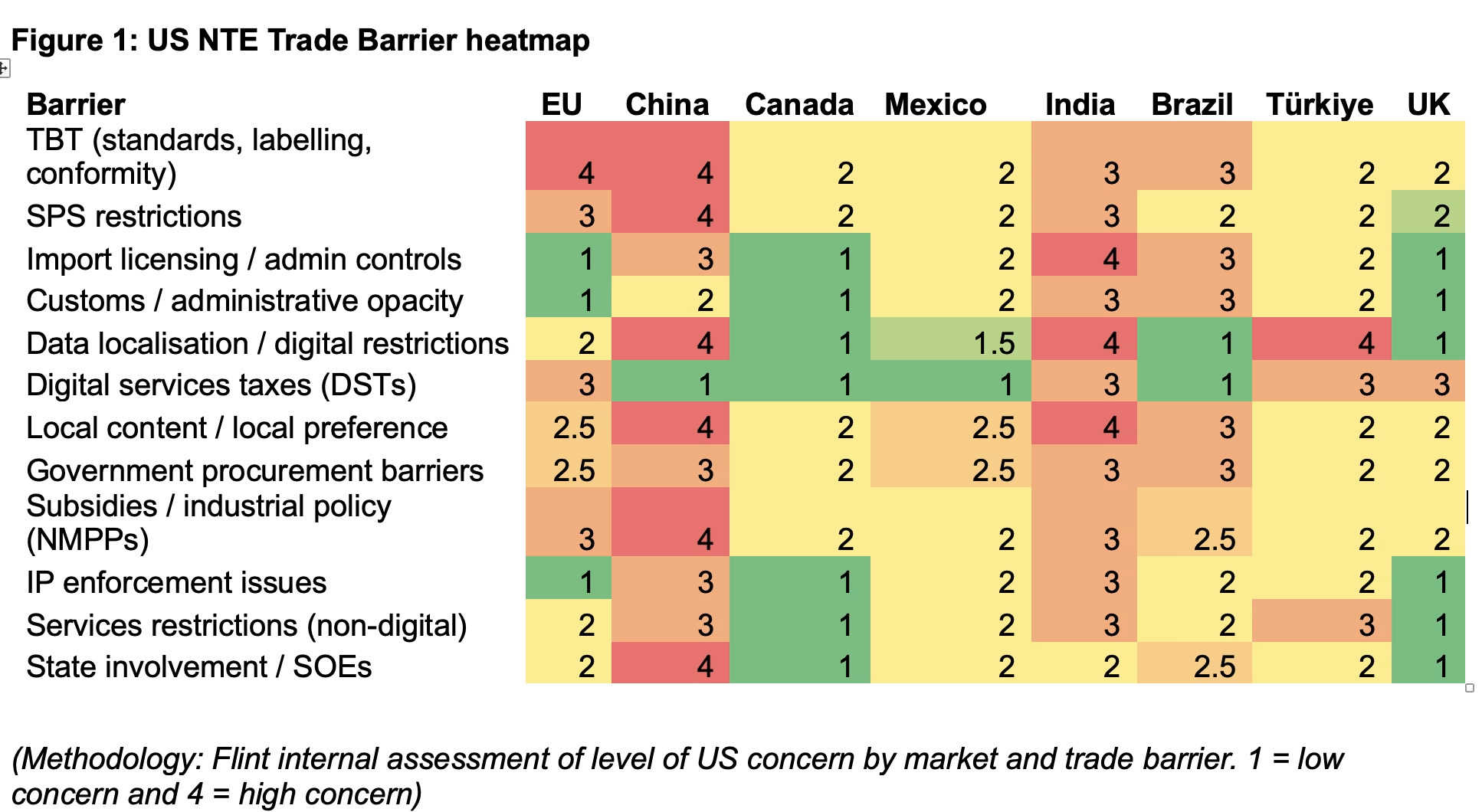
The March 2026 National Trade Estimate on Foreign Trade Barriers (NTE) report also provides a clear indication of where future investigations could emerge. Several themes recur consistently across major trading partners:
Alongside S301, Section 232 (S232) will remain the Administration’s primary sectoral tool. Framed around national security, S232 has already been used to target sectors including steel, aluminium, automotives, semiconductors, pharmaceuticals, copper, and lumber.
Importantly, S232 tariffs have in many cases exceeded the rates previously imposed under IEEPA. The Administration also continues to take an expansive view of what constitutes a national security concern, allowing tariffs to be extended into an increasingly wide range of industrial sectors and derivative products.
Several additional investigations are now approaching decision points, including probes into commercial aircraft, drones, polysilicon, medical equipment, and industrial machinery. The overall trajectory points towards continued expansion rather than restraint.
| Product category | Launch date | Commerce report due | 90-day decision deadline | Current status |
| Commercial Aircraft & Jet Engines | 1 May, 2025 | 26 Jan, 2026 | 26 April, 2026 | Decision Pending |
| Polysilicon & Derivatives | 1 July, 2025 | 28 March, 2026 | 26 June, 2026 | Decision Pending |
| Unmanned Aircraft Systems (Drones) | 1 July, 2025 | 28 March, 2026 | 26 June, 2026 | Decision Pending |
| Wind Turbines & Components | 13 Aug, 2025 | 10 May, 2026 | 8 Aug, 2026 | Ongoing |
| Medical Equipment & PPE | 2 Sept, 2025 | 30 May, 2026 | 28 Aug, 2026 | Ongoing |
| Robotics & Industrial Machinery | 2 Sept, 2025 | 30 May, 2026 | 28 Aug, 2026 | Ongoing |
The Administration may also explore more aggressive use of Section 122 or Section 338 authorities, although both routes would face significant political and legal challenges. At present, these appear more likely to serve as leverage or fallback options than primary tariff tools.
For businesses, the key takeaway is that the legal disruption to IEEPA has not materially altered the direction of US trade policy. Instead, it has increased complexity.
Companies should prepare for:
At the same time, the move towards a more piecemeal tariff architecture may create greater opportunities to secure product-specific exclusions, negotiated carve-outs, or preferential treatment linked to investment and localisation commitments. Recent discussions around pharmaceutical tariffs suggest the Administration is increasingly willing to link tariff treatment to domestic production, pricing, and supply chain resilience objectives.
This more sector-specific approach also creates additional pressure on businesses to engage proactively with both US authorities and foreign governments. Monitoring investigations early, mapping exposure across supply chains, and identifying potential exemption pathways will become increasingly important as tariff policy grows more layered and unpredictable.
This blog was written by Associate Directors Emilie Kerstens and Will Haworth, and Senior Adviser Matthew Lehrfeld. Emilie was previously at a Brussels-based consultancy advising on international trade and industrial policy with prior experience at a range of Brussels- and Washington, D.C.-based thinktanks focused on trade and economic policy. Will formerly worked in the UK Department for Business and Trade Department in the team responsible for the UK’s trade relationship with the US. Matthew is a former US diplomat of over twenty years, with postings across Asia, Europe and the Middle East. He also advises companies with the US Chamber of Commerce in Europe.
Enjoyed this blog? Sign up for our Trade Monthly newsletter for analysis of the political, policy and regulatory developments shaping UK, EU and global trade.